05. Feb.–20. März 2022
Helene Appel. Representation


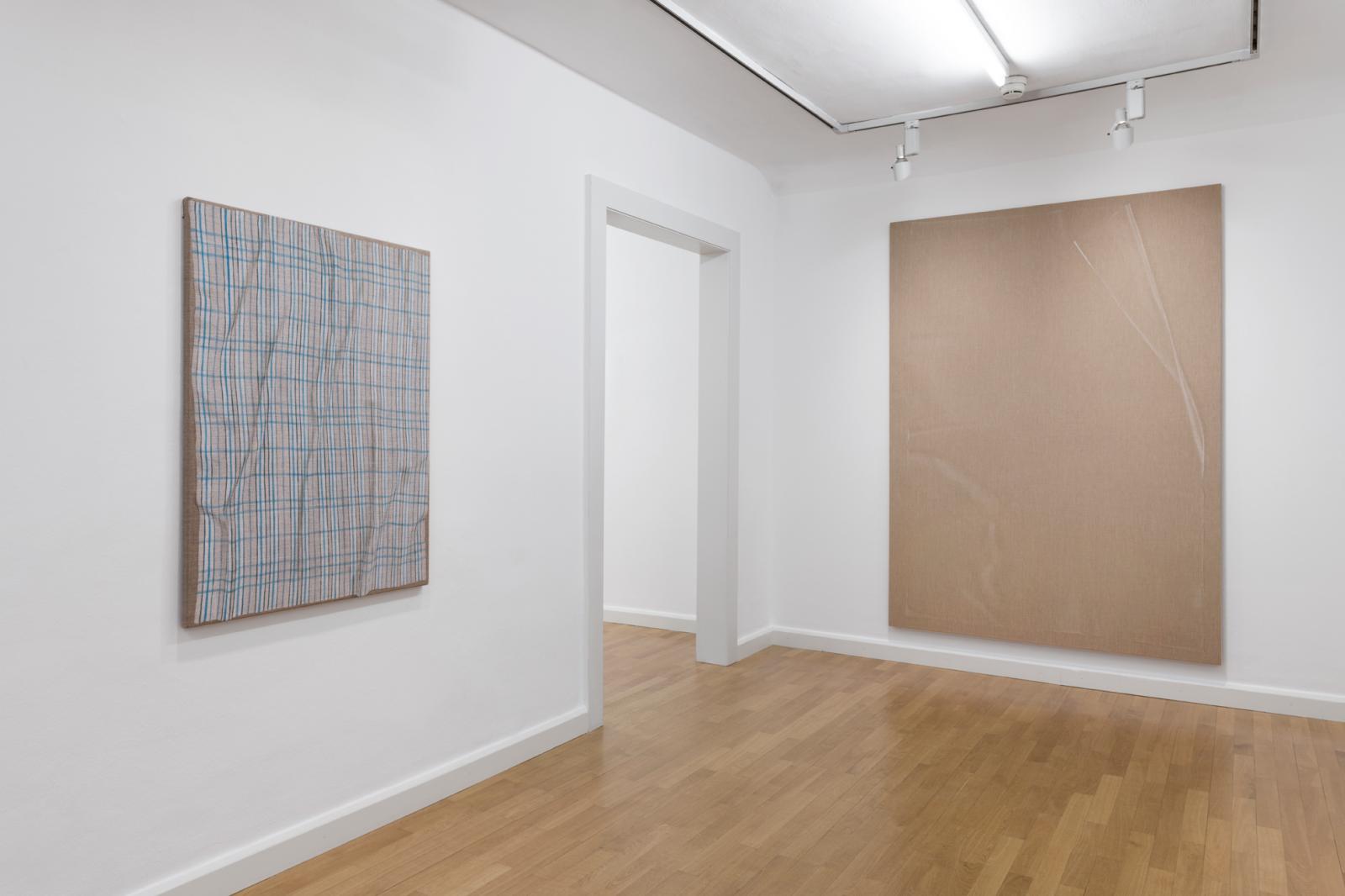


With Helene Appel, the Städtische Galerie Delmenhorst is honoring an exceptional painter who has long been represented by renowned galleries and recognized with awards such as the Goslar Kaiserring Fellowship. Helene Appel. Representation is her first institutional retrospective, which will subsequently travel to the Touchstones Museum in Rochdale, England. Parallel to the solo exhibition, three young artists with whom Helene Appel has worked at the Braunschweig University of the Arts (HBK) are being presented in the Städtische Galerie’s Remise under the title of matter. painting.
Helene Appel paints objects of everyday life: food, fabrics, fishing nets, or trees; plastic bags or puddles. In doing so, she adheres to a painterly concept: her subjects appear isolated and life-size on untreated canvas. Above all, however, Helene Appel always views the subject from an extreme high angle—in film, one would speak of a top shot, taken at a 90° angle to the object.
A closer look at the works reveals the radical nature of this approach. For Helene Appel does not develop a painterly signature or emphasize her own distinctive style. Instead, she seeks an appropriate medium and a plausible technique for each of her subjects. To depict raw meat, she uses encaustic—a technique in which paint is applied with hot wax. To depict water, she works with watercolor, which soaks through the canvas. When it comes to sand, the painted dots of color interact with the raised texture of the canvas.
It is above all this realistic mode of representation that immediately brings to mind classical still lifes. Since the 16th century, paintings of food, draped textiles, or precious plants have been created. Often these were allegorical depictions of luxury objects, which, through elaborate staging and a deceptive realism, served as a reminder of the transience of earthly life.
Pictorial illusionism not only gave artists the opportunity to demonstrate their technical skill, but was also part of a moral appeal not to be deceived by appearances. The artful placement of light reflections on a broken glass, flowers wilting for dramatic effect, animal carcasses killed during the hunt, wine seemingly carelessly spilled—all these motifs aimed at a “memento mori”: Remember that you must die.
At the same time, they demonstrated the fullness of life, prosperity, and sophistication, for the possession of fine textiles or exotic plants—the still life itself—always also highlighted the financial power of the patron. Although no people appear in these works, they deal with Homo sapiens, his economic and scientific achievements, and demonstrate his cultural and moral education and superiority.
The paintings by Helene Appel develop an entirely different dynamic; while they depict similar motifs in an illusionistic manner, they dispense with the spatial context. It is always a single object on which the artist focuses her full attention and which she encounters at eye level.
Depicting a fishing net in its entirety is an act of redundancy. From a distance, it is barely recognizable; the unprimed canvas, measuring eight square meters, appears empty. That it is in fact painted across its entire surface only becomes visible upon closer inspection and develops a hypnotic pull. Although the net consists of identical meshes of delicate nylon threads, every opening in the painting seems unique; nothing repeats itself here. Confronted with this wall-filling presence, associations unfold in various directions. The painting evokes different fishing techniques, as well as the often-discussed consequences of overfishing and the pollution of the oceans by torn nets. The small-format portrait of a leg cutlet also opens up vast spaces of imagination, in which factory farming features alongside culture-specific meat consumption or the waste and unequal distribution of food in the world.
Each work is an expression of intense devotion. Helene Appel invests a great deal of time in preparatory experiments to do justice to her subject matter through painting. She is not interested in portraying trophies; rather, she observes everyday, mundane objects and establishes diverse connections between people, things, and the environment. Her works move away from the primacy of the human figure toward the narrative networks in which we find ourselves.
Helene Appel (b. 1976 in Karlsruhe) completed a multifaceted academic education, studying at the Surikov Institute in Moscow and the academies of fine arts in Dresden and Hamburg. She spent one semester abroad at both Chelsea College of Art and the Royal College of Art in London. The artist has repeatedly been awarded scholarships, including one from the German National Academic Foundation. In 2011, she received the Kaiserring Fellowship from the Mönchehaus Museum in Goslar. She subsequently served as Artist-in-Residence at the Spanish Centre for Contemporary Art in Andratx. In 2019, Helene Appel received the two-year Dorothea Erxleben Fellowship at the Braunschweig University of Art.
The exhibition is supported by the Oldenburgischen Landschaft, the Niedersächsischen Ministerium für Wissenschaft und Kultur, the Stiftung Kunstfonds and the Hochschule für Bildende Künste Braunschweig.